Ceci n'est pas une endive

To content | To menu | To search

Tag - perso

Entries feed - Comments feed

Wednesday, April 23 2008

Choosing a Name: The First Name

I never got around to telling the story of our daughter's name. It is, indeed, one heck of a story, which starts even before she was born. You have to remember that she has a German father and a French mother. This led, before her birth, to endless dicussions about what names are suitable in both languages. We had a few criteria we tried to respect when choosing her first name.

The first criterion was pronunciation. We wanted to make sure that the name would not vary to much from one language to the other. This rules out all the names having very specific pronuciations, such as names starting with "J" for example, which the Germans make soft (as in yum) or "H", which the French tend to forget to pronounce altogether (Hans is "Ans" in French, and "Hans" in German).

Pronunciation is one thing, but spelling is another, which is actually related. We couldn't take a name that people couldn't read in one or the other language. This ruled out my favorite "Benoît" (Ben-o-wha in French, Ben-o-it for the Germans) and names with French nasals or specific French spellings (Agnès is read A-ni-es in French, Ag-ness in German, I find on nice, the other one not so).

Another criterion was ambiguity. Some names are very easily recognizable as female or male, others are just extremely ambiguious in one language, when they are not in the other. Again, Delphine is very French, but never leads to confusion about the gender. Arne, on the other end, written or spoken, for people who are neither Swedish, nor Northern Germans, is often mistaken for a woman's name. So we needed a name that would be very clear.

And finally of course, a name we both liked. Which is, as we found out, probably the hardest thing of all. Not som much because we have different tastes, but because cultural differences kick in very fast. The German sounding names I liked were either terrible, out of fashion, too fashionable or plainly unheard of, the French sounding name Arne liked were either terrible, out of fashion, too fashionable or plainly unheard of. Funny to see how much culture the name carries.

Well, we settled for the first name Emma, classic, simple, read and pronounced in most languages in exactly the same manner, hardly ambiguous, and which we both liked. It took us around nine months... And then came the last name. But this will do for another post.

Friday, November 16 2007

About "Ceci n'est pas une endive"

This blog has been turning in my head for quite a long time, actually ever since I gave a presentation at Wikimania last year in Taipei, about cultural differences.

The name is a funky one, but has a real history.

First, why an endive? Well, even though I did not really participate in it, the deadliest edit war I recall witnessing in the French Wikipedia was about the article endive. And the whole problem about this article was a cultural problem. In Belgium, and endive is called a chicon, not an endive (yeah, notanendive). So the whole question was whether this artcile should be called Endive, or Chicon. I will pass on the many qualificatifs used during that edit war, on the number of editors participating, on the people hurt in their cultural sensitivity etc. It was, as I said deadly. In the end, when one looks at the article, You might notice that no-one really won. Well, the article *is* indeed called "Endive", but throughout the text, and even if your French is non-existent, you will see that the word "Chicon" appears more often than the actual word "Endive". Which means that in a very wiki way, the authors of the article actually came to kind of a consensus concerning this article. (One might also notice that the page "Chicon" redirects to the page "Endive".) The apparent "French from France" supremacy - which one can see in the title of the article - is undermined by the Belgian cultural squad. (please, note the irony in the previous sentence).

I remember watching this from afar at the time, and thinking that there was, in the end, no real solution to the problem. The software is built in such a way that there must be a winner (a title to the page) and that this was a war lost in advance. Short of starting a Belgium-French Wikipedia, which probably would make little sense (as little as starting a whole France-French Wikipedia), there is little one can do not to show the one or the other "supremacy".

This endive/chicon example was one of the pillars of my presentation at Wikimania, because it illustrates one of my favorite themes, the trickiness of cultural differences in our every day life.

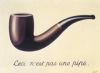
Second, why a French title for what intends to be an all-English blog? Well, as a tribute to the Belgians, which I am probably frustrating by using the word "endive" rather than the word "Chicon" in the title, I have chosen to paraphrase and pay hommage to one of their greatest painters, Magritte. You may know this painting:

Ceci n'est pas une pipe © René Magritte - Source: L'essentiel

Well known as a representation of Magritte pertainance to the surrealism movement. I thought that the allusion to a Belgian painter who stated the obvious would actually be an interesting way of introducing those ever underlying cultural trends which actually govern our lives and that we just don't know about.

Magritte's painting is in French, so I thought that would be a good tribute to my mother tongue. I however decided to use English as the main language of this blog. Not an easy decision, actually, but the one that makes most sense to me at this stage. I thought I'd use my own lingua franca to share my experience. It might occur that I will write in French when the post requires it, but I will try and make a point of providing English summaries to all my posts, as well as French summaries to all my English posts.

To finish, this blog intends to be a semi-serious blog about multiculturalism, living in another country, experiencing weird cultural shocks. It will probably be tainted by thoughts about non-profits, Wikimedia projects and other things taht have little to do with culture at all, but I promise to try and keep it on track.